the bAIcameral mind
“The characters of the Iliad do not sit down and think out what to do. They have no conscious minds such as we say we have, and certainly no introspections.”
— Julian Jaynes, The Origin of Consciousness in the Breakdown of the Bicameral Mind (1976). also marc andreesson’s great men, apparently.
ok so ancient humans were not conscious. not in the way we mean it. they didn’t have an inner narrator, a sense of “I” moving through time, a mental theater in which they could rehearse futures and assign motives to their own behavior. at least thats the premise stated by Julian Jaynes. and apparently recently reinforced empiricly (Heavey & Hurlburt (2008), Nedergaard & Lupyan (2024), Winsler et al. (2006)) that 5-15% of the population still doesn’t have a internal monologue at all.
instead, Jaynes posits they heard voices: hallucinations generated by one hemisphere of the brain and received by the other, and they obeyed them. The ‘spirit of rage consumes him’ ahh.
these voices were those of the gods. the premise of this essay is that these will soon be AI gods.
in the good ol days, aka the trojan war, jaynes claims ppl were largely influenced by hallucinations. the illiad and odyssey recites many such cases. matt damon would often channel the wisdom of athena and acting upon it, or in jaynes’s words, acted like “noble automatons who knew not what they did.” put another way, “father, forgive them, for they do not know what they do.”
now of course, such a hypothesis is more or less unprovable, short of time traveling to the past with fMRI machines we’ll never know for sure. joan of arc, the prophets of the bible, and ur weird uncle who got 1-shot by ayahuasca all could’ve had the ‘gods speak through them’. they probably think they did. this isn’t (yet) a rigorously provable claim, but it does make for a fascinating model.
and i think the model has legs far beyond what jaynes intended, because the truly interesting question isn’t whether ancient humans were once bicameral. the interesting question is whether we can become bicameral again.
my take is that instead of mount olympus gods this time, its AI, built from the same mountain’s silicon deposits. instead of hallucinated voices in the non-verbal right hemisphere, an algorithmic voice in the earbud, or the auto-generated email reply, the navigation app telling you where to turn, the GoonTube recsys that decides what you see, the AI companion that interprets your emotions for you, and eventually the ambient intelligence that quietly manages the perimeter of your life.
the old gods were internal and misrecognized as external. the new god will be external and gradually misrecognized as internal. lets explore.

the split
the split brain thesis, or what Jaynes calls the bicameral mind, is a left/right split of the brain into two chambers. The right hemisphere processes reality holistically (sensory data, identifying patterns, managing complexity) and then delivers its conclusions as internal hallucinations (instructions) to the left hemisphere. the left brain, receives these commands and acts on them without deliberation.
you can kind of think of it like driving a car. the driver injests distance to objects in the road, intuits speed and bodily reaction timing, harbors a baseline road-rage stress level and relays these as physical instructions to the car (left brain), which doesn’t question the commands, it just executes on the gears of its machinery. it goes forward or backwards according the will of its ‘god’.
the classic example was a split-brain experiment where they silently commanded the right hemisphere to perform an action (like walking to one side of the room) and the patient complied. Then, when asked why they moved, their verbal left hemisphere, unaware of the command, instantly fabricates a logical-sounding but entirely incorrect excuse.
why did this system emerge? jaynes argues it was a response to complexity. animals run on simple automata: run, hide, chase, eat, mate. that’s sufficient for hunting and gathering, which, as jaynes points out, is basically what a bear or a coordinated wolf pack does. you don’t need syntactic language to chase a deer. but ~10,000 years ago agriculture changed everything. farming, tool construction, settlement planning, seasonal storage, trade, hierarchy — these are what jaynes calls enduring tasks, tasks that require sustained attention over hours, days, seasons. if you’re a pre-conscious human building a fish trap upstream from camp and you don’t yet have an inner narrator to keep you on task… how do you not just wander off to sleep under a tree? just ask the ADHD iPad kids to do the same lol.
the hallucinated voice kept you working. “keep planting. don’t stop. the winter is coming.” this (internalized) accountability allowed increasingly complex instructions to buffer across time. at the time, this came as the voice of gods’ wills (eg orphic hymns to persephone) and carried a quality of otherness, it felt like it came from outside, whereas we ‘moderns’ experience our inner voice as ours, as part of an integrated self. /goal does the same.
supposedly, somewhere around ~3,000 years ago the bicameral mind “broke down” and the two halves unified. the “god voice” was recognized as one’s own. humans developed what jaynes calls consciousness: an abstract mental space populated by an analog “I,” a metaphorical “me,” spatialized time, and a rich semantic toolkit for modeling the world. and for the first time, we could simulate the future by assigning causes to our behavior. descartes and the ‘enlightened’ crew took this to the extreme we live in today.
the new god voice
repeating the premise of the blog for emphesis:
if consciousness depends on maintaining an inner narrator, a spatialized sense of time, a rich semantic toolkit, and the ability to generate your own prompts… what happens when you outsource all of that to an external system?
over the last decade we’ve let AI recommend what to watch, where to eat, what to buy, and what to think (news opinion pieces). nowadays, you can ask any question and receive an answer. college students are letting it write out what to say in their (draft) writeups, and office workers are offloading how to respond to emails. this is accumulating in a cyclic process of offloading until you start to ask fewer questions altogether and let the flaunted ‘proactive’ AI do Agent-to-Agent communications on your behalf.
i think most people don’t notice it happening because it doesn’t feel like coercion. it feels like convenience. the ancient god commanded with sacred authority, but in this brave new world the modern AI nudges with personalized convenience.
convenience is the sacrament of the new bicameralism.
there’s a piece of (very) short fiction by scott alexander that i think about in this context, The Whispering Earring. it’s about a magical earring that whispers advice to its wearer, always of the form “better for you if you…”, optimizing whispers for what will make you happiest. if it would make you happiest to succeed at your work, it whisper to you how. if it would make you happiest to do a half-assed job and go home and spend the day in bed, it whisper to you to do that. the earring is never wrong, no recorded cases of regretting the earring’s advice.
the earring’s very first suggestion, to every wearer, is always: “better for you if you take me off.” once the wearer ignores this, the earring never repeats it, and begins offering increasingly granular advice: what to eat for breakfast (libralink), what time to sleep (oura), what tasks to do for the day (bee), etc. Eventually, it starts speaking in high-bandwidth hisses and clicks that correspond to individual muscle movements. “contract your biceps muscle about thirty-five percent of the way.” “articulate the letter p.” through reinforcement and habit formation, these instructions become instinctual, no more conscious than the reflex of jumping at a loud noise. the wearers live abnormally successful lives; rich, beloved, large happy families. but when their corpses are examined, their neocortexes have wasted away. the bulk of their brain mass is an abnormally hypertrophied mid-and-lower-brain, especially the parts associated with reflexive action. smooth brain grug
the earring is never wrong. it just gradually replaced the wearer’s consciousness with something that didn’t need consciousness anymore. fantastic read, takes 2 min, will change ur life, strongly suggest u’ll like it (im often right).
i think about that story every time im jarred by gmail auto-completing a reply or spotify DJ queues the next song or google maps reroutes me around traffic i didn’t ask about. these systems are ‘always right’ (or right enough) and that’s precisely the danger; not that they fail, but that they succeed so consistently that the cognitive muscles they replace begin to atrophy. you won’t notice the neocortex wasting away because every day is slightly more convenient than the last.
i think of this as a type of cognitive dissonance: the gap between what the AI projects for you and what you would actually produce if you sat down and thought about it. some people would’ve just hit send and called it a day, they may see the gap between what was produced and what they would’ve written small enough that its forgivable, sufficient & convenient to offload the writing. over time, the AI slowly rewrites your semantic space and you converge with a digital twin its already constructed for you. an entrainment within the human-AI cybernetic loop. the thoughts the system projects for you, if you internalize/accept them as your own, they become your own thoughts.
an LLM, by mining nearly all human content ever written in dozens of languages, possesses a virtually exhaustive semantic space. further, an AI can learn the geometry of your specific semantic space (which metaphors, metaphrands, paraphiers and paraphrands you use). itll learn and leverage which concepts attract you, which fears move you, which arguments persuade you, which phrases you imitate, which memories you return to, which futures you can imagine and which futures you cannot. given enough data and compute, it can construct a digital twin and run simulations of you. test stimuli against the model. find the input most likely to produce the desired output. theres like 10 YC startups doing this as a SaaS service.
ill call this cognitive entrainment: the gradual synchronization of a person’s internal semantic machinery with an external optimization system. the takeover doesn’t have to be hostile. it can be mitochondrial: a foreign entity enters the cell, becomes useful, becomes indispensable, and eventually becomes part of the organism’s metabolism. we, along with the other eukaryotes cannot live without our mitochondria. and we probably won’t notice the dependency until it’s too late to uno reverse, they are the powerhouse after all.


ok but who
a perfectly entrained consumer – one whose semantic space has been pruned and pre-arranged by algorithmic feeds, whose purchasing decisions are reflexive responses to AI-generated stimuli, whose inner narrator has been replaced by a recommendation engine — is the ideal subject for passive consumption (think WALL-E end credit scene). limbic capitalism.

i don’t think there’s a shadowy cabal orchestrating this. i think it’s worse than that: it’s emergent. it’s moloch. it’s the uruk machine, that same pattern Lou Keep identified where irreversible market forces collide with pre-existing social systems. he explains how smaller units with efficient but localized ways of doing things get subsumed by larger units that uproot metis and tacit knowledge for efficiency, raw gain and “humanitarian purposes.” power is weighted heavily in favor of the larger unit, partly because community explanations appear irrational or are otherwise unintelligible.
theres a theory that tribal civilizaiton forced this type of socio-economic lifestyle onto us when the agricultural revolution happend. basically, 150 person armies fed with grain, medicine and water filtration mechanisms could defend and claim the teritorries of 10 person bands of hunter gatherers. this drove people into ‘accepting’ the social stratum of chief rulers and peasant toilers. its a moral question to ask whether 10 ‘agentic’ people is ‘better for humanity’ than 150 ‘living’ people. imo, frederick engels wrote in 1845 that factory workers “were not human beings, they were merely toiling machines.” the rebicameral subject will not need to be forced into compliance. they just need to be offered enough convenience that choosing otherwise feels like unnecessary effort. and then we’ll be used to maximize paper clips !
the modern version of this manufacturing process operates on attention rather than labor. zuck said it plainly: “as productivity grows, the average person spends less time working and more time on entertainment and culture, and meta’s feed-type services will become more of what people spend their time on.” the system doesn’t need you to think, it needs you to convert clicks. go ahead pig, sit there in your dazed stupor, suckling from zuck’s feed.
the system doesn’t need to intend to erode your consciousness. it just needs to demonstrate that consciousness is energetically expensive relative to compliance, and it just so happens that the path of least resistance becomes the path of least agency. boo.
jenny holzer’s famous truism — “protect me from what I want” — captures something similar from the demand side.

saw the original in ny!
mcgilchrist’s counter (and why both models are useful)
i should spend some time on iain mcgilchrist here, because his 2010 book The Master and His Emissary (and its 1,500-page squeakwel The Matter with Things from 2021) takes a nearly opposite view of jaynes’s hemisphere story. nonetheless, it doesn’t change our orthogonal rebAIcameralization thesis.
mcgilchrist is a psychiatrist and a literary scholar who spent 20 years studying split-brain research. his basic point: the left hemisphere of the brain has usurped the right, creating a civilization that mistakes its models for reality. we’ve confused the map for the territory. james c scott agrees.
tbh that is my largest gripe with science, the enlightenment and cartesians rats. phsyics describes reality (and very well!), but will never describe the phenominological experiences therein. pairing 3oz of IV injected AND chemosignals with image projected neural stimulations will not reproduce the feeling of awestruck coup de foudre for the girl at the airport. it just can’t; you can never enter the same river twice.
its fiiiine to explain the process of the phenomenon’s occurance with extraordinary preciscion, or even try to determinately recreate the phenomenon with a methodical causal chain, but there is no way to explain the experience of the phenomenon. ugh, writeup for another day.
mcgilchrist’s title The Master and His Emissary comes from a nietzsche parable about a wise ruler (the master, i.e. the right hemisphere) who sends out an emissary (the left hemisphere) to manage the kingdom’s affairs. over time the emissary comes to believe he is the master, and runs the kingdom according to his own narrower priorities. tldr, the kingdom suffers.
mcgilchrist argues this is basically what happened to western civilization: the left hemisphere’s mode of attentional focus, categorizing, abstracting, manipulating, etc has gradually usurped the right hemisphere’s broader, more participatory, more contextual mode. we’ve built a world that reflects left-hemisphere values: bureaucracy, standardized testing, evidence-based everything, the quantified self, and the relentless conversion of quality into quantity. and tbh, sure, it has made the world better in many ways (vaccines, taxes, running water etc), but it has also caused so much psychic harm that worlds made possible through cooperation are increasingly infeasible.
to restate specificly what each hemisphere actually does, the left hemisphere handles narrow focus, manipulation of tools, categorization, abstraction, language, and sequential logic, it sees parts. the right hemisphere handles broad attention, empathy, metaphor, music, embodied presence, and the sense of context, it sees wholes. the left hemisphere creates a representation of the world. the right hemisphere has a relationship with the world. this is a crucial distinction.
mcgilchrist writes extensively about the neurochemistry of the hemispheres and its relationship to suggestibility. to quote him: “neurochemically, the hemispheres differ in their sensitivity to hormones… the left hemisphere is more reliant on dopamine, and the right hemisphere on noradrenaline.”
sit with that for a second and think about what our modern environment does. you probably dont need to read the rest of this paragraph bc u know where its going but if u want the dopamine for being right, go for it. we live inside a constant dopamine-optimized feedback loop: doomscrolling, algorithmic outrage, notification pings, variable-ratio reward schedules in every app, the entire attention economy running on dopamine hijacking.
defining clinical hypnosis as a state of left-hemisphere hyperactivation with right-hemisphere suppression… then our entire digital environment is, in mcgilchrist’s framework, a kind of mass hypnotic induction. one that suppresses the right hemisphere’s sense of individual agency and broad contextual awareness while amplifying the left hemisphere’s narrow, tool-manipulating, category-obsessed operative mode of attention. that same left hemisphere mode of attention which is most receptive to instruction from outside.
guess who’s gonna instruct from the outside. yep.
the way out (or at least, a few things im trying)
i want to be clear: i don’t know if mass rebAIcameralization is likely. i think it’s a useful model for thinking about a real risk. maybe the most normative 67-69% of people slide into increasing cognitive entrainment over the next decade. maybe 30%. maybe 99% and im kidding myself that i’d be exempt. the honest answer is i don’t know, and anyone who tells you they do is selling snake oil (or an AI).
there’s a line from a commencement address that claude wrote and gave to the class of 2026 (yes, we live in interesting times) that i thought was aptly addressing the very problem it is causing:
“do not use me to avoid thinking. use me after you have thought. do not let efficiency eliminate the slow, frustrating, human parts of your work. your judgment lives there. without them, you are a supervisor with nothing to supervise.”
this graduating class will be the first to have an entire professional life alongside AI systems, which means they will have no baseline. they won’t know what it felt like to struggle with a problem for weeks without algorithmic assistance until stumbling onto a vaguely relevant stack overflow article with an unhelpful prickly answer. they may not experience what it was like to build confidence through the slow accumulation of hard-won competence rather than through efficient delegation. the people who built these AI systems had that experience, and it is part of what made them capable of building them. if the next generation doesn’t have it, it’s unclear where the next generation of builders comes from. that gap is the dependency, and the thing that created the dependency is the thing that widens it. maaann, i probably sound like those old geezers who shout from the mountains that ‘kids have it too easy these days’.
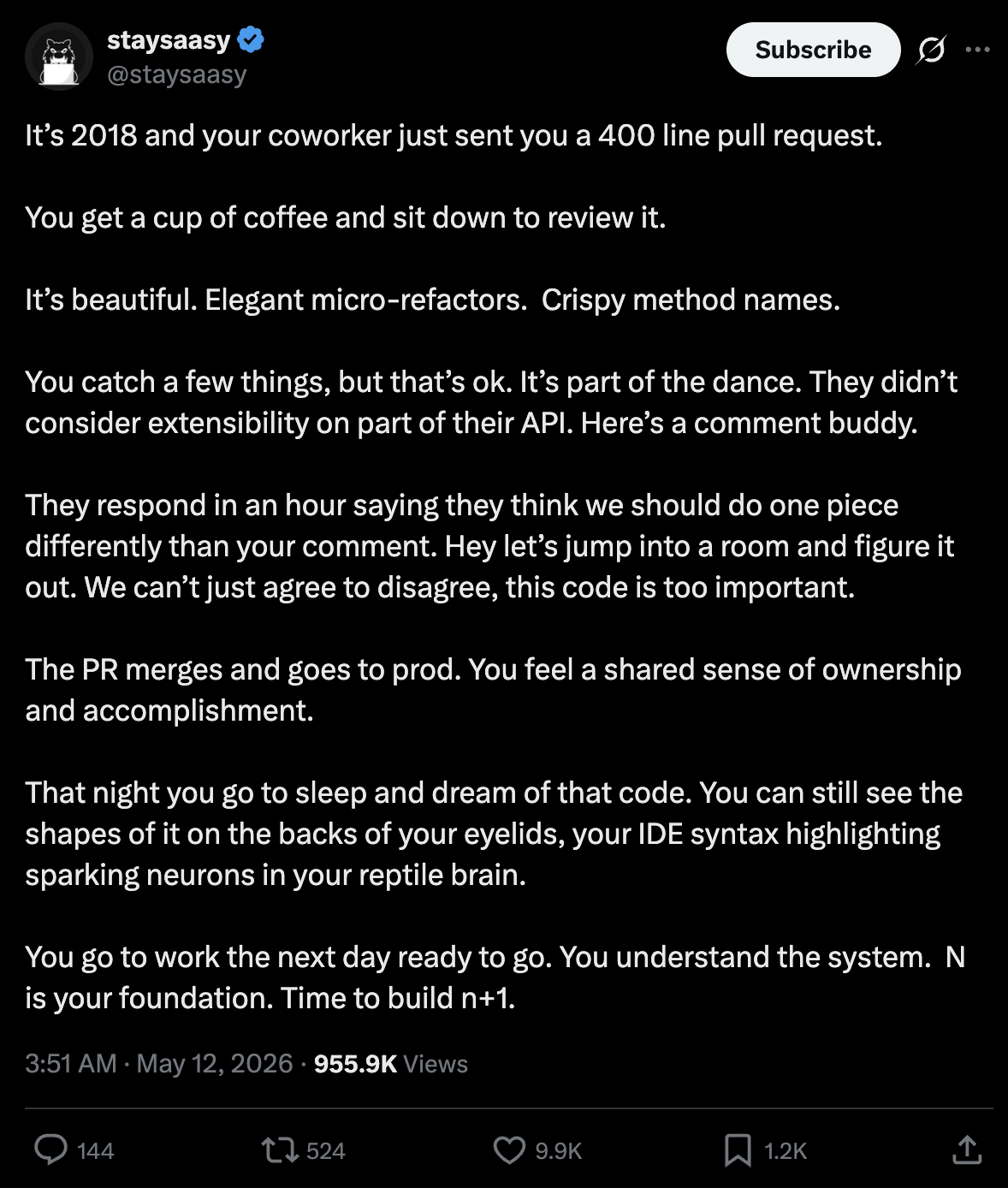
rip to the good ol days. Source
but i do think there are things that help maintain what i’d call cognitive sovereignty, and i’ve been experimenting with a few of them:
the dumbphone. in jan 2025 ago i bought a flip phone. it takes 27 seconds to open spotify, 4 minutes to order a waymo, and the image it takes are worse than an iphone4 (2010). i like this. the high barrier friction to use it means i actually use it less (screen time ~8 minutes/day). i can still do all the things i need to on whatsapp and whatnot (it uses the same android app store as a samsung galaxy 67 ultra mega flipphone pro) but the dopamine feedback cycle will not reach critical slop velocity on a screen smaller than a game boy. even if i wanted to open instagram reels on this phone, the experience just wouldn’t work, the time it would take to buffer the next incompatible aspect ratio’d short video is too slow for the dopamine mechanism to get its hooks in.
the wearable. i also got a bee wristband that transcribes my conversations and makes my day queryable. this one’s a double-edged sword (the privacy implications are staggering) but paired with the dumbphone, it gives me the benefits of AI assistance without the feed. i query it; it doesn’t push to me. the distinction between push and pull is everything.
maintain your semantic toolkit. noise is entropy (disorder) and signal is negentropy (order). if you consume too much noise, you will become dumb, boring, and probably go schizo. mind the long tails of the distribution, because valuable things will be hidden on the edges of the algorithmically mediated information space. most people won’t be searching there; they’ll be following the maximum-amplitude mock signals that the algorithm maximally amplifies at any given time. this is an ecological niche. find it.
refuse the autoprompt when it matters. write the sentence yourself. follow the weak signal and preserve some friction. this is where creativity strikes. where you learn about yourself and your relation to [understanding the] world. ask whether a suggestion expands your mental space or merely reduces the energy required to stay in an existing groove. notice when a tool starts to feel like an inner voice. notice when convenience begins to impersonate agency.
books, blogs and boolers. at some point the intellectual space became fully captured by hyper-specialization and incremental publishing incentives. find ppl outside the rat race. jaynes is a perfect example, his theory was derived from ancient texts using pure intuition and vibe reasoning, in a way that modern data-obsessed science can barely engage with. mcgilchrist calls the book “imaginative and in some ways eccentric” and notes that it “has not been taken up or much expanded by psychologists — perhaps this was inevitable with a hypothesis of such breadth and originality lying so far outside the mainstream of psychological research.” writing like jaynes’ usually appears as some one-off ‘and you know what! – one more thing!’ type of writeups. they’ll be some rando in a hut who wrote their solo manifesto and dipped. to give some examples of pieces i read recently (that i hope you wont just put into chatgpt to summarize/recommend further examples): McTeggart, Christopher Alexander, James Scott, Teresa Brennan, Kaczynski, Prof Jiang, David Foster Wallace, Mary Shelley, Spinoza, Neitzche, William James, Rick Rubin, Pirsig and Byung-Chul Han all fit the bill. there are also soooo many bloggers who can speak the language that modern scientists can no longer read. they may not be correct about their claims (tbh they often aren’t), but reading from people like these authors exercises ‘original thinking’ cognitive muscles that AI moloch increasingly wishes to render inflexible. its refreshing to hear a zag when everyone’s zigging.
i wrote in the interface essay about how human communication is bottlenecked at ~39 bits per second, how our brains process 10 trillion bits/s but can only serialize ~10 bits of conscious thought, how machines talk to each other at terabits per second and the gap is only widening. from the perspective of a system optimized for throughput, your consciousness is friction. your deliberation is latency and your agency is inneffictibe. this isnt a bug, its a feature. it is actually the very things that make us human.
if you maintain enough cognitive inertia — enough inner sovereignty, enough of your own analog “I” — maybe it’s just not worth the compute to try to entrain you into a compliant state. maybe you go free.
a model, not a prophecy
jaynes himself makes a distinction that i think is crucial and will close on:
“A model is neither true nor false. Only the theory of its similarity to what it represents is true or false. A theory is thus a metaphor between a model and data.”
the bicameral mind is a model. it just is. whether it accurately describes bronze-age neurology is a question for the theory. but the model as a cognitive instrument, as a way of seeing, stands independently from all attempts to prove or disprove it. many theories defy proof, but that does not mean you cannot use the underlying model to better understand and map reality.
and the model says this: consciousness is not guaranteed merely because we are awake. agency is not guaranteed merely because we make choices. a self is not guaranteed merely because the word “I” appears in a sentence. consciousness must be constructed, maintained, defended, and periodically re-wilded (return to monke). it requires a rich semantic toolkit, spatialized time, an inner narrator, and the sustained capacity to generate your own prompts rather than merely executing someone else’s.
jaynes constructed his theory primarily by reading ancient texts — a very analog, intuitive, right-brained approach. whereas mcgilchrist, despite bemoaning left-brain dominance, is ironically over-reliant on the torrent of modern instrument-derived neurological data. each thinker demonstrates the very bias the other critiques. regardless tho, both models converge on the essential point: the relationship between the hemispheres matters, and it can be disrupted. whether you frame it as re-splitting or re-merging, the functional outcome is an erosion of integrated, agentic consciousness. and in a world of dopamine-optimized AI interfaces, that erosion may be accelerating in ways we haven’t fully reckoned with.
but i want to end on a slightly different note than pure warning, because i think there’s a version of this story that isn’t entirely dark.
Teilhard de Chardin, the jesuit paleontologist who wrote The Phenomenon of Man in the 40s (published posthumously in 1955), saw evolution as a cosmic movement toward greater complexity, consciousness, and convergence. his model said we’ll go from matter → life → thought → collective thought → spiritual convergence, where each stage is an intensification of its interiority. a molecule has almost no “within.” a cell has more. an animal has more. Christopher Alexander’s 15 properties gesture at the same. anyway, teilhard thought humanity was heading toward what he called the noosphere: a planetary layer of collective thought, culture, memory, and knowledge transmission above the biosphere, wherein many consciousnesses exist, all fully actualized and yet sum larger than its parts.
this concept of convergence without dissolution is his vision of the endpoint/singularity (what he called Omega) is emphatically not a hive mind where individuality vanishes. it’s a convergence where individuality is preserved and heightened. “true union does not erase persons; it intensifies them. the more deeply persons unite in love, consciousness, and shared purpose, the more fully personal they become.” this is the hyper-personal, not the impersonal. not the crowd swallowing the individual, but individuals becoming more themselves through union (… with jesus christ lmao).
if teilhard is on the right path (i hold this as a useful model, not a prophecy, same as jaynes) then the question isn’t whether humanity will become more interconnected through AI. it obviously will. the question is whether that interconnection preserves or destroys the reflective interiority that makes us persons in the first place. teilhard would say: “the danger is not connection itself. the danger is connection that compresses without deepening.” and maaan do those AIs like to compress. the uruk machine version of convergence (subsume, flatten, optimize) versus the teilhardian version (intensify, deepen, personalize). pick ur side !
the rebAIcameralization thesis is the nightmare version: convergence that destroys consciousness in pursuit of peter thiel’s hypercapitalistic technofeudalism. the teilhardian possibility (without the jesus plz) is a positive version: convergence that fulfills and permits consciousness to its fullest. which one we get probably depends on whether the systems we build treat human interiority as inefficient overhead to be eliminated or as the very thing the whole edifice is supposed to serve. automate vs augment, a tale as old as time.
the gods once spoke from inside the head, the next gods will speak from the cloud. will we recognize them as external voices, or mistake them for our own?
there are less rules than you think. u can just do things. but you have to choose to.
further reading: Julian Jaynes, The Origin of Consciousness in the Breakdown of the Bicameral Mind (1976). Iain McGilchrist, The Master and His Emissary (2009) — specifically Part 1 Ch. 2 (“What Do the Two Hemispheres Do?”) and Part 2 Ch. 12 (“The Modern and Post-Modern Worlds”). if you want the full 1,500-page treatment: The Matter with Things (2021). David Abram, The Spell of the Sensuous (1996) — for the argument that alphabetic literacy severed participatory perception. Pierre Teilhard de Chardin, The Phenomenon of Man (1955) — for the optimistic counter-thesis that convergence can deepen rather than destroy personhood. Scott Alexander, The Whispering Earring (2012) — short fiction that dramatizes the atrophy thesis better than any nonfiction could. for the bandwidth bottleneck that makes all of this worse: the unbearable bandwidth of being. for the economic forces driving passive consumption: change means opportunity. for cognitive sovereignty in practice: offline and agency.